
November 18, 2026

ChordMoods
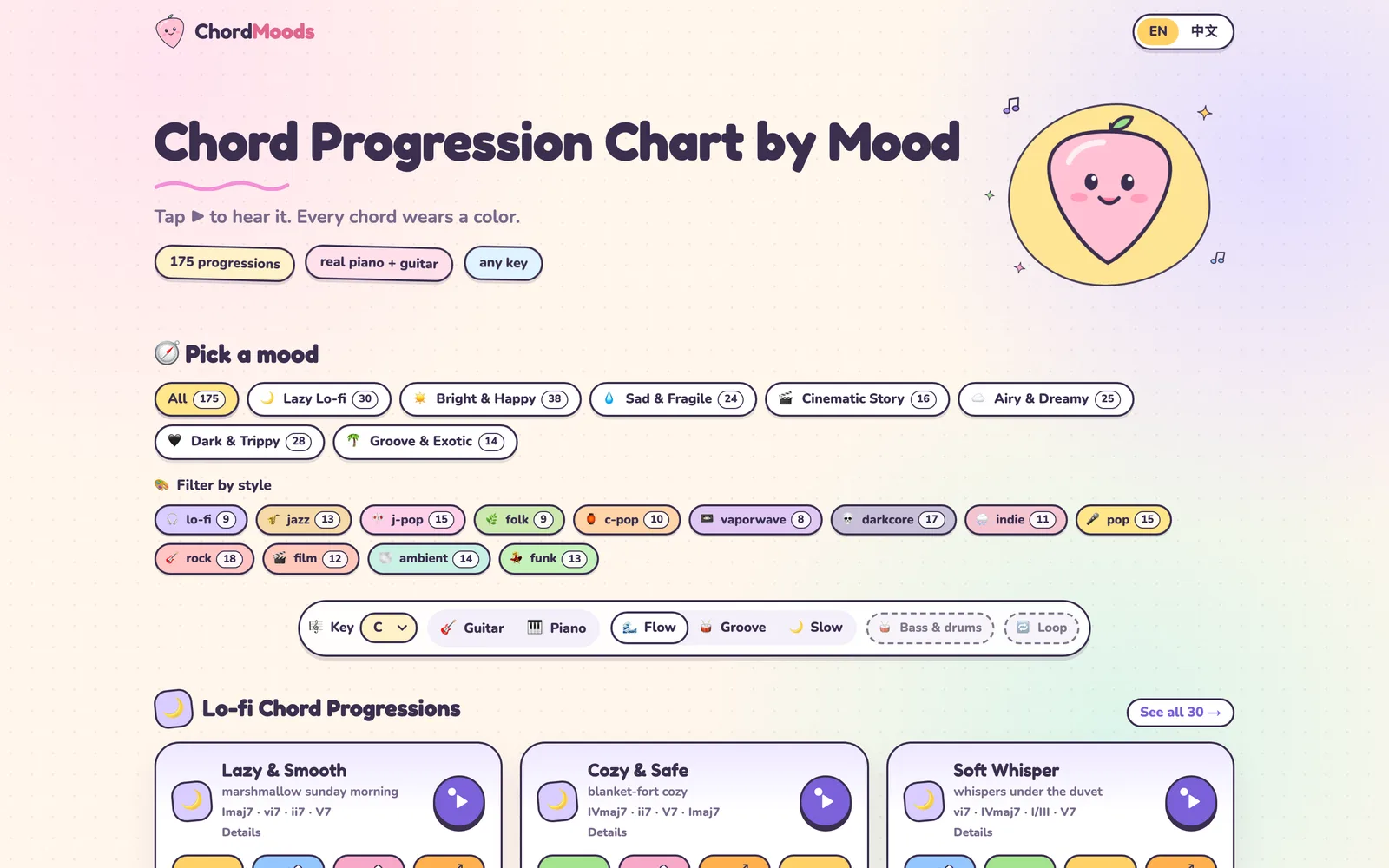
175 guitar and piano chord progression charts organized by mood and style, helping creators quickly find the right chords.
Product facts
- Type
- Web App / SaaS
- Category
- Creativity & Media › Audio and Music
- Pricing
- Free
- Launched
- Nov 18, 2026
- Listed
- Nov 18, 2026
- Website
- chordmoods.com
Overview
ChordMoods is a web-based chord progression reference tool featuring 175 guitar and piano progressions. It's built for songwriters, beginners, and anyone who gets stuck on the first few chords when writing a song. By categorizing chords by mood and style, it lets you preview them directly and pick the perfect progression.
Key Features
- Browse by Mood: 7 mood categories including Lo-fi, Happy, Sad, Cinematic, Dreamy, Dark, and Groove, each containing multiple chord progression cards.
- Filter by Style: Filter across 13 musical styles such as lo-fi, jazz, j-pop, folk, c-pop, vaporwave, darkcore, indie, pop, rock, film, ambient, and funk.
- Realistic Audio Previews: Click any chord card to play it back using authentically sampled piano (Salamander Grand Piano) and guitar (Karoryfer Samples) sounds.
- Key Transposition: All progressions are shown with both specific chord names in C and Roman numerals, letting you switch to any key.
- Fretboard Diagrams: Click any chord to see its shape on the guitar fretboard.
- Color-Coding System: Each chord gets a fixed color based on its function in the key (e.g., I is yellow for home, vi is blue for longing, V is orange for tension). Seventh and suspended chords add a second descriptor (e.g., maj7 for glow, m7 for mellow, sus for hanging). This lets you grasp the emotional logic of a progression visually before you even play it.
Who It's For
Ideal for songwriters seeking chord inspiration, guitar or piano beginners just learning chords, and music lovers who want to understand basic harmonic functions without reading sheet music.
Key features
- 175 Chord Progressions: A collection of 175 guitar and piano progressions covering a wide range of moods and styles.
- Browse by Mood: Progressions sorted into categories like Lo-fi, Happy, Sad, Cinematic, Dreamy, Dark, and Groove.
- Filter by Style: Filter across 13 styles including jazz, j-pop, folk, c-pop, vaporwave, pop, and rock.
- Real Instrument Samples: Click any chord card to hear it played back with authentically sampled piano and guitar tones.
- Switch to Any Key: Displays both chord names and Roman numerals, with one-click transposition to other keys.
- Guitar Fretboard Diagrams: Click any chord to view its fingering shape on the guitar fretboard.
- Color-Coding System: Uses colors and words to label each chord's role in the key, helping you understand harmonic movement.
- Loop & Backing Modes: Offers Loop playback and Bass & drums backing track options.
Releases
Notify me Initial · ChordMoods
Q&A
- What is a chord progression chart?AI-generated
- It's a reference list of chord sequences for songwriting or practice. ChordMoods organizes them by mood and style, showing each progression with both specific chord names in C (like C–G–Am–F) and Roman numerals (I–V–vi–IV), making it easy to transpose to any key.
- What are the most common chord progressions?AI-generated
- Common ones include I–V–vi–IV and its variation vi–IV–I–V in pop, I–vi–IV–V from 50s doo-wop, ii–V–I in jazz, IV–V–iii–vi in J-Pop and anime, and I–IV–V in rock, folk, and blues. They're all listed here, grouped by mood.
- Are these chord progressions suitable for beginners?AI-generated
- Yes. Everything defaults to C major or A minor, mostly using open chords like C, G, Am, F, Em, and Dm. Click any chord to see its fretboard diagram. If the F barre chord is tough, try Fmaj7 instead, or use the transposition menu along with a capo.
- How do I write a song using this chart?AI-generated
- Pick a mood, preview a few cards until one clicks, then loop it and hum a melody. Choose a different progression on the same page for the chorus, or borrow one from a neighboring mood for contrast. Once you've settled on your vocal range, transpose the key so the melody feels comfortable.
- Why does every chord have a color and an emoji?AI-generated
- The colors represent each chord's function in the key—I, IV, V, and vi always keep the same color no matter what key you're in. The emojis and words beside them (like home, longing, tension) describe how they sound. It's a visual way to learn harmony without reading sheet music.
Bookmark
This product has no owner yet
It was listed by the platform or its author left. If it is your work, prove your relationship to become the owner.
Claim this productAlternatives

Mp3toMidi
Turn MP3, WAV, and M4A audio into editable MIDI online.
Released 3 days ago8
Freemium

AirMusic
An AI-powered web music generator that helps creators quickly produce original songs and music videos from text or lyrics.
Released 4 weeks ago29
Freemium

Hooktheory
Software and interactive learning materials for musicians to write melodies and chord progressions.
Released last month25
Freemium

Lyrics to Song AI
Turn lyrics into songs with AI vocals and accompaniment—no music theory or recording gear required.
Released last week35
Freemium

MixSongs
Mix, trim, change tempo and pitch for free in your browser, and use AI to split songs into 6 stems.
Released 4 weeks ago22
Freemium

YinsoAI
A web-based AI music creation app that generates original songs from ideas or lyrics.
Released last month12
Freemium

AutoPiano自由钢琴3D版
A free online virtual grand piano. Play using your keyboard, mouse, or MIDI keyboard directly in the browser.
Released last month11
100% Free

AI Music Maker
Enter a text description to generate a complete song with vocals, lyrics, and accompaniment.
Released last week25
Free trial

Kleep
AI song generator that turns text, lyrics, or ideas into complete original songs with vocals.
Released 4 weeks ago11
Freemium
Free Online Harmonium
Play the harmonium for free in your browser, with keyboard shortcuts, MIDI input, and Indian classical music practice tools.
Released last month7
100% Free
The product content on this page was translated by AI from the author's original.